Letter No. 109 · Purpose & Identity · The Archive
Self-Love Isn’t Selfish.
The Line Between Solitude And Isolation.
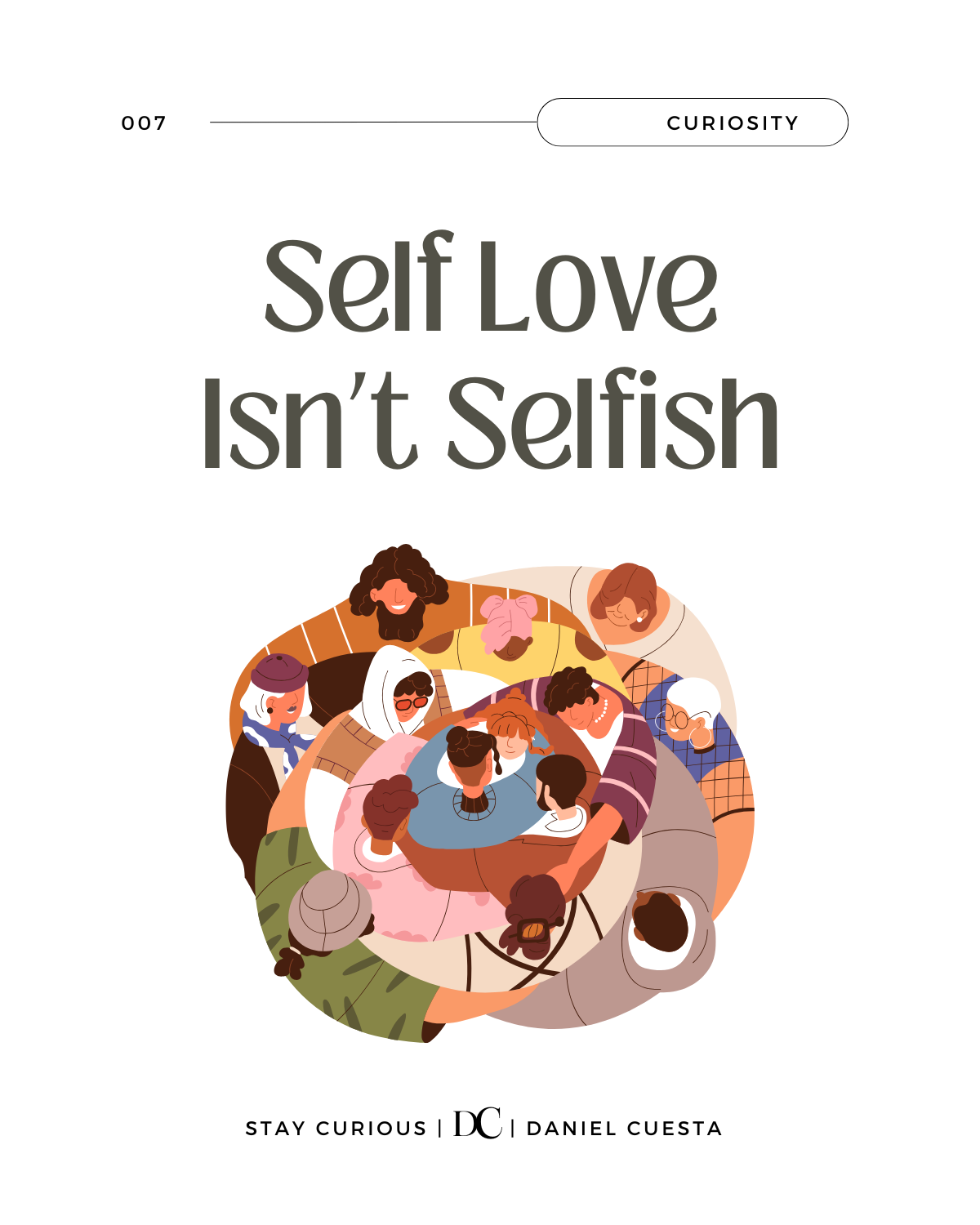
It’s an easy mistake to make. One we have all done—confusing solitude as recharging.
Isolation feels like self-care, pulling away looks like “taking time for yourself,” and “me-time” sounds like an acceptable excuse for being alone… in many ways, they are.
But there is a fine line that must be drawn in this sand, and that’s the difference between Self-Love and Selfishness. As the greatest lies are the ones we tell ourselves, we mustn’t trick our minds into believing caring for oneself is centered only on us. It’s not. Allow me to explain.
In the previous article, we discussed the importance of self-love and reframed this practice through the lens of “Treat yourself like someone you are responsible for helping.” We explored how this positions who we are as a vessel that needs maintenance and care, and not just something we can expect to go-go-go without a pit stop. This said, the world has tricked many of us into confusing selfishness with self-love, a fine line we can trip over when we’re not careful.
The main distinction between these two lies in one simple question: Is what you do filling your cup in order to fill those of others around you, or is it truly and only self-serving? This will look different to different people but comes down to overvaluing yourself at the expense of others.
This life was not designed for us to do alone. So much so that from the beginning of its inception, God clearly indicates it’s not good for man to be alone (Genesis 2:18). Community is consistently brought up in Scripture, in which we are called to forgive, encourage, and carry each other’s burdens. We are told to pray for one another, confess our sins to our brethren, and share in learning. But above all, the greatest commandments themselves explicitly say we are to 1) “love the Lord our God with all our strength, soul, and mind,” AND 2) “love our neighbor as ourselves.”
Love who? Our neighbors. As who? Ourselves.
That right there is the key. Self-love was always meant to tie back to community. It’s a two-in-one deal. You take care of you in order to then take care of others. You cannot have one without its counterpart. They are bound. That is the delicate balance we must somehow strike.
Yes, you should stand up for yourself and find space where needed, but simultaneously, you should remember that the whole reason we pull away is to prepare ourselves to get back in the game. In this life, we are all part of a tribe that together functions to uplift one another.
—
An empty cup cannot fill another empty cup, hence our need for rest and self-preservation. But at the same time, once our cups are filled, we were made to share that joy with the world.
Only you can decide how far is too far; your boundaries should be set and respected. But this life isn’t about you. Love is about sacrifice. We see this clearly in the greatest demonstration of love there has ever been: the Son of God beaten, bruised, and bloodied as a sacrifice for our own sins. All forms of good love require tradeoffs.
Maybe it’s taking that call from a friend even though it’s late and you wanted an early night. It could be helping a family member with an errand even though you would have rather stayed home watching a movie. It’s waking up early to prepare lunch for the kids (thank you, mama), and it’s staying up to watch cartoons with your son even though you need to be up at five a.m. (thank you, papa).
It all harkens back to the greatest commandments. This week, I wonder what our lives would be like if we all loved our neighbor a little bit more as we love ourselves.
- Making The Most Of Being Curious Daniel J. Cuesta
~ Wednesdays Of Wisdom ~
Share Wednesdays Of Wisdom (W.O.W)
Sources:
The Greatest Commandment: One of the teachers of the law came and heard them debating. Noticing that Jesus had given them a good answer, he asked him, “Of all the commandments, which is the most important?” “The most important one,” answered Jesus, “is this: ‘Hear, O Israel: The Lord our God, the Lord is one. Love the Lord your God with all your heart and with all your soul and with all your mind and with all your strength.’ The second is this: ‘Love your neighbor as yourself.’ There is no commandment greater than these.”
Strength In Community: “Two are better than one, because they have a good return for their labor: If either of them falls down, one can help the other up. But pity anyone who falls and has no one to help them up. Also, if two lie down together, they will keep warm. But how can one keep warm alone? Though one may be overpowered, two can defend themselves. A cord of three strands is not quickly broken. - Ecclesiastes 4:9-12
**A Call to Community: **Therefore encourage one another and build each other up, just as in fact you are doing. - 1 Thessalonians 5:11
871 words
Links in this piece
Wednesdays Of Wisdom · danielcuesta007.com