Letter No. 123 · Friendship & Relationships · The Archive
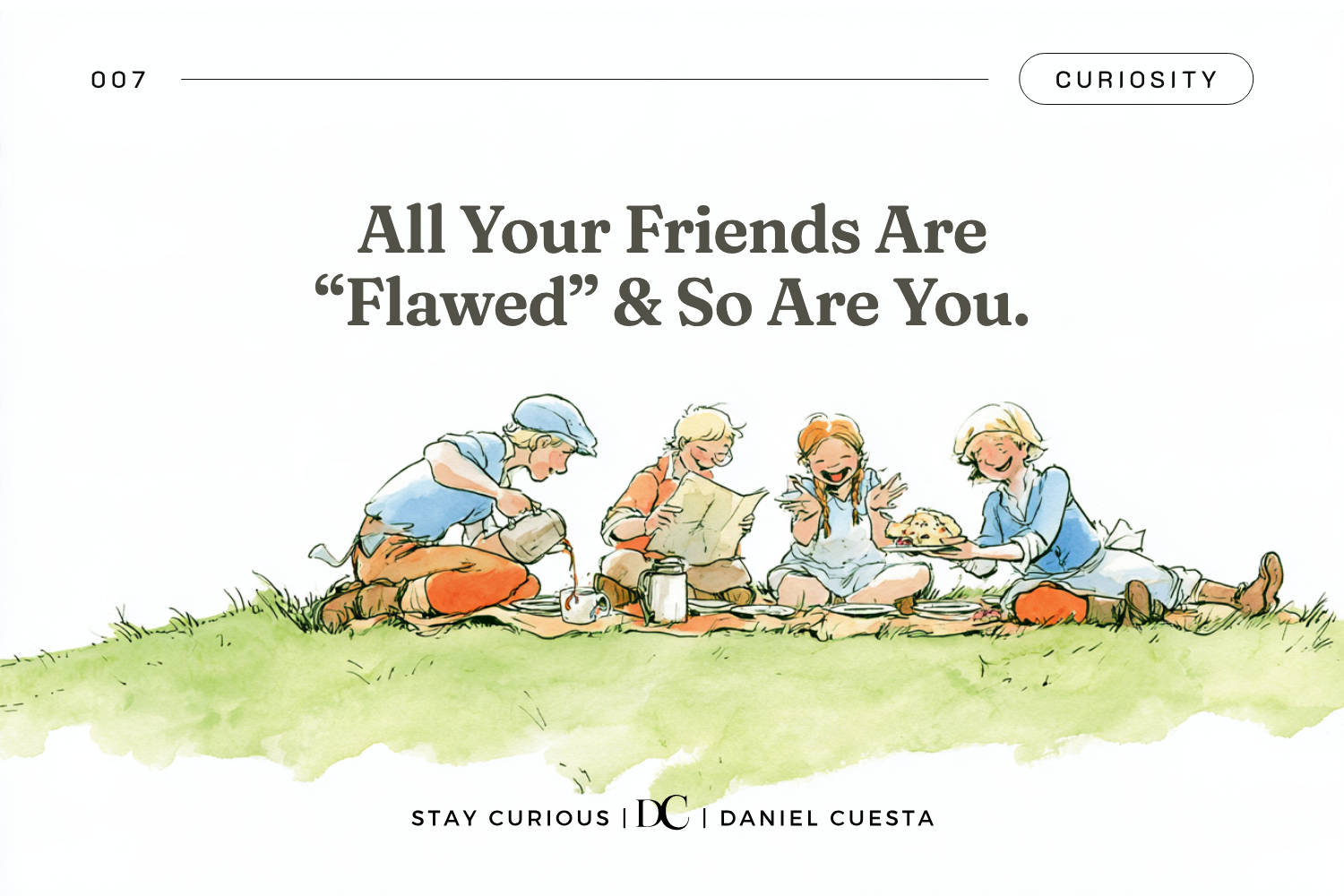
All Your Friends Are “Flawed” & So Are You.
Love 'em anyway, with mercy and hope… flaws and all.
Disappointment is not a negative emotion; it is a signal; it’s an input telling you where to pay attention. It will always flag your awareness and tell you what needs workshopping. The troubling thing is when that disappointment, that signal, is associated with someone you love, or perhaps even yourself.
It’s not always as simple as “move on”, “dust yourself off”, or “try again”. Usually, trust is put under tension, leaving us with a series of decisions about how to rebuild.

I have come to the realization that this is because you, along with all your friends, are “flawed”. Yes, we each have some form of quirk, particularity, or defined set of naturally occurring emotions that are par for the course when choosing to have us around.
When said this way, it seems obvious and clear that, of course, we all have our differences, but the truth is we are too eager to identify our strengths and shy away from identifying our weaknesses, or, in other words, our imperfections. Those are areas of life where we struggle or need help, because they do not come “naturally” to us.
Today we are exploring how to deal with these, for your sake and those of your relationships.
1. The Grace Margin Principle: Leave room for people to be human, and God to be God.
If we put our hopes in man, we will always be disappointed, for man is mortal and we suffer from the human condition. It can be beautiful and still a burden; this is why the Grace Margin Principle matters. It teaches us to approach life and those in it with a preemptive sense of mercy, the same Christ offers us. One in which, regardless of previous mistakes, you treat others (and yourself) with kindness, allowing wiggle room for the moments we need help.
This, of course, is not an argument for naivety. Being gracious and sharing an understanding heart with others is not a call to blind trust nor eager submission. But it is one in which we act with charity, knowing full well that our ultimate responsibility is to God.
Practically, this looks like leaving room for ourselves and those around us to be human; after all, we all have the right to a bad day. It means seeing past these faults and not defining someone by shortcomings but by their greater evidenced character.
It should be noted that for stubborn or proud individuals, this may be difficult. In such cases, even more grace and graciousness are required of us.
Lower your expectations of others and raise them in the Lord.
2. Leverage The Pygmalion Effect: Higher hopes in others lead to greater people overall.
You may not have heard this phrasing before, but the Pygmalion Effect, also known as the Rosenthal effect, is a more formal term for what we colloquially call a “self-fulfilling prophecy.” Often, what comes true is what we expect, because we tend to see what we “think” is true, not what really is. (Its counterpart is the Golem Effect, in which low confidence in others leads to wasted effort and diminished self-esteem.)
Simply put, people become what you expect, especially that which you consistently and confidently believe them to be.
Building on the previous point, leveraging the Pygmalion Effect takes the grace with which we view ourselves and our relationship and adds the crucial layer of hope. Yes, we must first approach with understanding and faith in the Lord, but true friendship loves you where you are and pushes you toward who we know you could become. It hopes, and it holds out. A true friend believes. This also applies to how we see ourselves. We should be merciful to ourselves, and we should be the first to believe in ourselves too.
My thought is that in a world where we get to choose what to enact, why not call on the one that sets us and our relationships up for greater success?
The funny thing about dealing with others’ flaws is that most of the work doesn’t actually require them; it requires us. The trap is that we regularly expect the rest of the world to “be like us”. When we do this, we set ourselves and our friendships up for failure.
Stop expecting them to behave like you would, BECAUSE THEY ARE NOT YOU. I know that’s quite groundbreaking, but it’s true. Nobody thinks exactly as you do; we are all different. We can either go mad about it or learn to accept it and evolve into the Christ-like individual who levels up to keep going.
Some are directionally challenged; others can never arrive on time; a few are bad at texting; some talk way too much about themselves. Love ‘em anyway, with mercy and hope… flaws and all.
This week, I challenge you to reassess your shortcomings through the lens of mercy and hope. Do the same for your friends. Give everyone grace for their imperfections, reminding yourself that Christ did this first. Then actively choose to see the good rather than the worst.
Love people as God loves you (as you are). Believe in them as He does. And give freely; one day, you will be grateful you did.
— Making The Most Of Being Curious
Daniel J. Cuesta
Share this letterPair this letter with a cup from Addisuna Coffee Co.

~ Wednesdays Of Wisdom ~
W.O.W Sources
The Grace Margin Principle: This righteousness is given through faith in Jesus Christ to all who believe. There is no difference between Jew and Gentile, for all have sinned and fall short of the glory of God, and all are justified freely by his grace through the redemption that came by Christ Jesus. - Romans 3:22-24
The Pygmalion Effect: Therefore encourage one another and build each other up, just as in fact you are doing. - 1 Thessalonians 5:11
973 words
Links in this piece
Wednesdays Of Wisdom · danielcuesta007.com